Satellite remote sensing has revolutionized our understanding of Earth’s atmosphere, but merging data from different instruments—each with unique strengths—remains one of the biggest scientific challenges. A new study published in Atmospheric Measurement Techniques (2025) presents a major step forward: the extension of the Complete Data Fusion (CDF) algorithm to tomographic (2D) atmospheric retrievals.
This innovation could significantly enhance how scientists integrate limb‑viewing and nadir‑viewing satellite data, ultimately improving our ability to observe and understand complex atmospheric processes.
What’s New in This Study?
The researchers successfully extended CDF to handle two‑dimensional (2D) tomographic retrieval products. This enables the fusion of datasets that include both vertical and horizontal information—crucial for capturing the geometry of atmospheric structures.
To demonstrate this, they tested the method on simulated ozone datasets from two future missions:
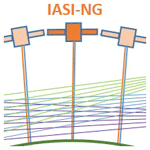
- IASI‑NG (Infrared Atmospheric Sounding Interferometer – New Generation), a nadir‑viewing instrument
- CAIRT (Changing‑Atmosphere Infrared Tomography), an ESA Earth Explorer 11 candidate mission providing limb tomographic observations.
These two sensors observe the atmosphere in very different ways. By combining them using 2D CDF, the study shows how advanced fusion techniques can make far better use of their complementary strengths.
How Did the Authors Test It?
The performance of the extended CDF method was evaluated across three case studies—one 1D scenario and two 2D scenarios—each with different configurations of the two sensors. For each case, the researchers quantitatively assessed:
- Degrees of freedom of the fused product
- Shannon information content
- Total error reduction
- Spatial resolution improvements
These metrics are essential for determining whether the fusion effectively increases the usable information in the dataset.
Key Findings
The results are striking:
- 2D CDF significantly enhances the information content compared to both individual datasets and 1D CDF.
- The method effectively leverages the tomographic capabilities of future limb‑viewing missions like CAIRT.
- It maximizes complementarity between instruments operating with different geometries and spectral ranges.
- The approach provides a robust framework for future multi‑mission atmospheric observing systems.
In essence, by adding horizontal structure to the fusion process, scientists can extract deeper, more precise insights about the atmosphere—particularly for variables like ozone that have strong spatial gradients.
Looking Ahead
As future missions like IASI‑NG and CAIRT come online, algorithms such as the newly extended CDF will be essential tools. They will allow researchers to combine ultra‑high‑resolution limb measurements with the dense global coverage of nadir instruments, providing a more complete picture of our changing atmosphere.
The paper not only demonstrates feasibility but sets the foundation for the operational use of tomographic data fusion techniques in atmospheric science.