
Monitoring the Earth’s ozone layer—especially in the complex region where the upper troposphere meets the lower stratosphere (UTLS)—remains one of the biggest challenges in atmospheric science. A recent study published in Atmospheric Measurement Techniques introduces a breakthrough: a new fused ozone dataset created using Complete Data Fusion (CDF) applied to measurements from the MIPAS and IASI satellite instruments. This innovative approach brings unprecedented clarity to ozone behavior over the Himalayas, a hotspot for stratospheric intrusion events.
Guidetti et al. (2026) developed an ozone dataset by combining:
-
- MIPAS limb observations aboard ESA’s Envisat satellite, and
-
- IASI nadir observations aboard EUMETSAT’s MetOp satellites.
These instruments operated simultaneously between 2008 and 2011, providing complementary views of the atmosphere.
This fusion—using the Complete Data Fusion algorithm—enhances our ability to detect and quantify ozone variations in the UTLS, a region crucial for understanding climate interactions and air quality.
Why Combine MIPAS and IASI?
Each instrument sees the atmosphere differently:
- MIPAS provides high-vertical-resolution limb sounding but with limited spatial coverage.
- IASI delivers dense global coverage but lower vertical resolution.
By merging the strengths of both instruments, the authors generated a dataset with:
- Improved vertical detail
- Expanded spatial coverage
- More robust uncertainty estimates (including covariance matrices, averaging kernels, and a priori profiles)
Why Focus on the Himalayas?
The Himalayan region is a major gateway for stratosphere–troposphere exchange (STE) processes. For climate and air‑quality models to capture these events, they must rely on accurate, vertically resolved ozone data. Until now, limitations in instrument coverage and resolution made this difficult.
This new dataset significantly strengthens our ability to track ozone intrusions in this sensitive region.
How Was the Dataset Validated?
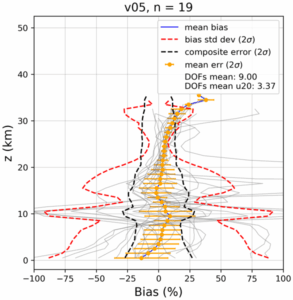
After tuning the fusion algorithm with 2008 data, the researchers validated the dataset (2009–2011) using ozonesonde profiles from the World Ozone and Ultraviolet Radiation Data Centre (WOUDC).
Results show:
- Enhanced vertical information content
- Reduced uncertainties
- Successful propagation of detailed MIPAS information into IASI’s layers
- Biases—initially inherited from IASI—were significantly corrected
The final dataset proved reliable across multiple latitude bands.
Why This Matters: Applications and Impact
The fused dataset is more than a scientific exercise—it’s a new tool for the atmospheric research community. According to the study, it is well-suited for:
- Data assimilation in weather and climate models
- Atmospheric reanalyses
- Studies of troposphere–stratosphere exchange
- Model evaluation of ozone transport and chemistry
Because the CDF method is computationally efficient and flexible, this approach may become a standard for merging satellite datasets in the future.
In Summary
This publication represents a significant advance in ozone monitoring. By combining the complementary strengths of MIPAS and IASI, the authors created a dataset that improves both vertical resolution and global consistency—especially in scientifically critical regions such as the Himalayas.
As ozone continues to play a central role in climate and atmospheric chemistry, enhanced datasets like this will be vital for predicting and understanding the dynamics that affect our planet’s protective shield.
https://amt.copernicus.org/articles/19/167/2026/amt-19-167-2026-assets.html